
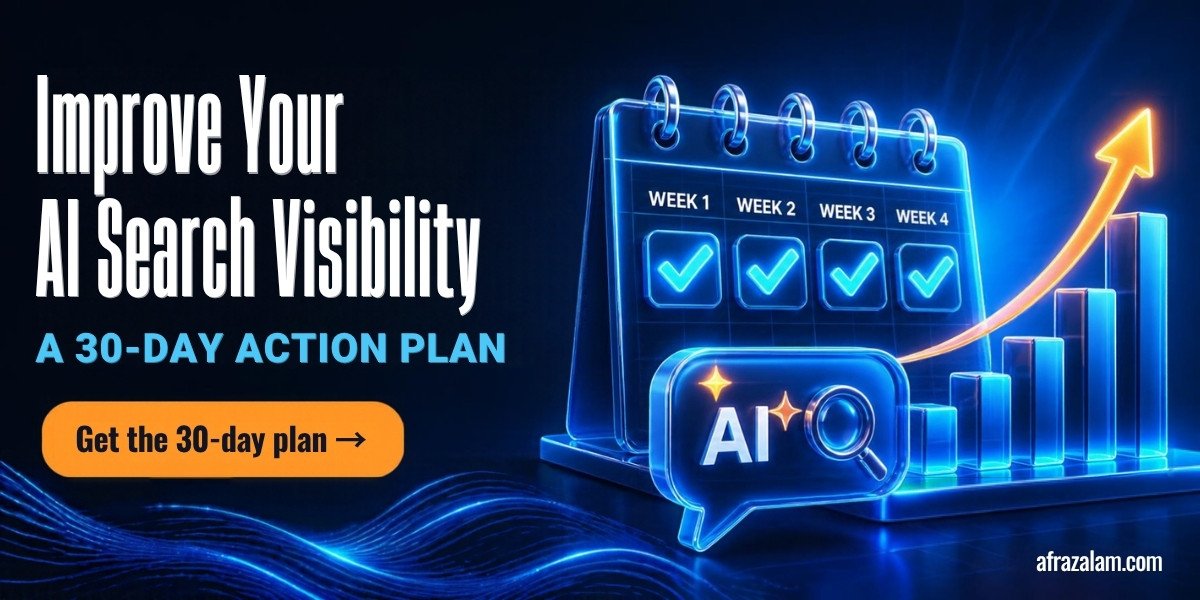
To improve AI search visibility, work in this order: measure where you stand and remove the blocks that keep AI crawlers and Bing out (week 1), rewrite the 5 pages that answer your buyers' questions so the answer comes first (week 2), earn real mentions on the third-party pages the engines already trust (week 3), then publish comparison pages and re-measure (week 4). Most businesses do these out of order and spend month 1 on content nobody can retrieve.
Business owners ask me some version of "how do I get my business on ChatGPT" every week. There is no form to fill in. There is no listing to claim. ChatGPT, Perplexity, and Google AI Overviews recommend you when their retrieval systems find pages that answer a buyer's question and trust what those pages say. Improving AI search visibility is the work of making that happen on purpose.
Here is that work laid out as a 30-day plan. Each week has a job, a deliverable, and a reason it comes before the next one.
In this guide
- Why the order matters more than the tactics
- Week 1: measure and unblock
- Week 2: rewrite the 5 pages that matter
- Week 3: earn mentions where the engines already look
- Week 4: publish comparisons and re-measure
- The plan for a DTC brand, a coach, and an HVAC company
- How long it takes to improve AI search visibility
- What this plan does not do
- The verdict
Why the order matters more than the tactics
Every tactic people use to improve AI search visibility is public knowledge. Answer-first pages, schema, Reddit mentions, comparison content. The reason most businesses still see no movement is sequence, not secrets.
If OAI-SearchBot is blocked by your CDN, nothing you write in week 2 reaches ChatGPT. If your About page, Google Business Profile, and directory listings disagree about what you do, the engines get conflicting facts and hedge. If you earn a Reddit mention before your site has a page that confirms the claim, the mention goes nowhere. Each week below removes the thing that would waste the next week.
The 3 engines retrieve differently, and I covered the mechanics in how ChatGPT, Perplexity, and AI Overviews choose their sources. This plan is built around those differences, which is why Bing shows up in week 1 and comparison pages wait until week 4.

Week 1: measure and unblock
The job: know your baseline and make sure every engine can reach and index you.
Day 1 to 2, baseline. Run the 15 AI brand visibility prompts across all 3 engines and score them. Keep the spreadsheet. Everything after this is measured against it.
Day 3, crawler access. Open your robots.txt and your CDN or firewall rules. 3 bots need to get through: OAI-SearchBot (OpenAI's crawler for search results, separate from GPTBot which is for training), PerplexityBot, and Googlebot. OpenAI's own documentation says a site must allow OAI-SearchBot and permit traffic from its published IP ranges to be eligible for ChatGPT search. One blocked bot removes you from one engine entirely, and many security plugins block "AI bots" as a group without telling you.
Day 4, Bing. ChatGPT search leans on partner indexes, and Microsoft is one of the 2 partners OpenAI names. If you are not indexed in Bing, you are not in ChatGPT's candidate pool. Set up Bing Webmaster Tools, import your site from Google Search Console, submit your sitemap, and check the indexed page count. This takes 15 minutes and it is the single most skipped step I see.
Day 5 to 7, facts. Make your About page, your Organization and Person schema, your Google Business Profile, your LinkedIn company page, and your top 5 directory listings say the same thing: what you do, who you serve, where you are, who runs it. Add a visible "Last updated" date to the About page and your key service pages. Engines hedge when sources conflict. Remove the conflict.
Deliverable: a baseline score per engine, 3 crawlers confirmed allowed, Bing indexing confirmed, 1 consistent set of facts everywhere.

Week 2: rewrite the 5 pages that matter
The job: give the engines pages they can lift an answer from.
Pick 5 pages: your main service or category page, your top 2 product or offer pages, your About page, and the 1 blog post closest to a question buyers actually ask. Not 50 pages. 5.
For each one, do 4 things. Put the buyer's question in the heading, worded the way they type it, not the way your brochure says it. Answer it in the first 100 words, in 2 to 4 plain sentences, before any story or pitch. Add a short FAQ with the 3 to 5 follow-up questions your inbox gets, each answered in a paragraph that stands on its own. Put a real author name and a real date on the page.
Google's documentation is explicit that there are "no additional requirements" to appear in AI Overviews and "no special schema.org structured data" you need to add. So this week is not about markup. It is about whether paragraph 1 answers the question. A 900-word page that answers in line 1 beats a 4,000-word guide that answers in paragraph 12, on all 3 engines.
I showed a full rewrite of a real page in How to Get Cited by ChatGPT. Use the answer capsule template from that post on all 5 pages.
Deliverable: 5 pages that state the answer first, carry a dated byline, and have a standalone FAQ.
Week 3: earn mentions where the engines already look
The job: get your brand onto the third-party pages the engines retrieve for category questions.
This is the week most people skip because it is not on their own website, and it is the week that moves category prompts. When a buyer asks ChatGPT for the best option in your category, the pages it retrieves are review sites, Reddit threads, industry roundups, and comparison articles. If you are not on those pages, you are not in the answer, no matter how good your site is.
4 places to earn mentions in 7 days. Review profiles: claim and complete your Google Business Profile, Trustpilot, or the review site your category uses, and ask your last 10 happy customers for a review this week. Reddit: find the 2 or 3 subreddits where your buyers ask for recommendations and answer questions as yourself, with your real name and no link-dropping, for the whole week. Roundups: find the "best [category]" articles that already rank and email the author with 1 specific reason you belong, plus a real customer result they can quote. Local news or podcasts: for a local business, 1 quote in a local outlet or 1 podcast guest spot puts your name on a trusted domain.
None of these are instant. All of them compound, because each one is a page the engines re-read every time someone asks the category question.
Deliverable: 10 new reviews requested, 1 week of real Reddit participation, 3 roundup pitches sent, 1 local or podcast placement in progress.
Week 4: publish comparisons and re-measure
The job: win the comparison prompts and measure the month.
Comparison and alternatives questions ("[competitor] vs [you]", "best alternatives to [competitor]") are where buyers with intent live, and they are usually answered by whichever side published the comparison page. Write 2 this week: an honest "[your brand] vs [top competitor]" page with a real table and a clear "who should pick which" verdict, and a "[competitor] alternatives" page that includes you and 3 or 4 others fairly. Honest means you lose some rows in the table. That is what makes the page get cited.
On day 28, measure whether you actually did improve AI search visibility: re-run the same 15 prompts in the same order and compare to your week 1 baseline. Look at the 3 engine totals side by side, not the grand total. Where the zeros moved tells you what worked. Where they did not tells you what month 2 is for.
Deliverable: 2 comparison pages live, a second score per engine, and a 1-line read on each engine's movement.
The plan for a DTC brand, a coach, and an HVAC company
| Week | DTC brand | Coach or consultant | HVAC, plumbing, electrical |
|---|---|---|---|
| 1. Unblock | Check your platform's bot settings (Shopify stores: keep product data clean, Shopify is a named ChatGPT partner). Fix inconsistent brand facts across Amazon, Instagram, and your site. | Make your About page, LinkedIn, and offer page describe the same method and the same client. Add a real bio with a date. | Match name, address, phone, and hours across Google Business Profile, site footer, Bing Places, and the top 3 directories. Confirm license details appear on the site. |
| 2. Rewrite | Top 2 product pages: who it is for, who it is not for, the 3 questions support gets, and a real comparison against the 2 alternatives buyers consider. | Write the page that answers "how does [your method] work" in 80 words, then link it from the offer page. The explainer gets cited. The offer page gets the click. | Service pages built around the symptom question ("AC blowing warm air in Phoenix"), with price ranges stated, not hidden. |
| 3. Mentions | Reddit product threads, gift guides, review-site profiles, and 1 or 2 niche roundups. | Podcast guest spots, LinkedIn posts that get real comments, and 1 roundup of coaches in your niche. | Google reviews this week, Nextdoor and local Facebook groups, 1 local news quote on a seasonal topic. |
| 4. Compare | "[Brand] vs [competitor]" and "[competitor] alternatives" pages with real specs and prices. | "[Your program] vs [big-name program]" page: honest fit table, who should choose which. | "[Company] vs [largest local competitor]" page: response time, pricing model, licenses, warranty. |
How long it takes to improve AI search visibility
Week 1 fixes show up fastest on Perplexity, because it retrieves live and weights freshness. Expect brand prompts (what is [brand], is [brand] legitimate) to improve first, often within the month, because they depend on your own pages and those are the pages you just fixed.
Category prompts move slowest, because they depend on third-party pages you do not control. Week 3 work usually shows in the month 2 or month 3 re-run, not month 1. Google AI Overviews follow your Google rankings, so a page that does not rank on page 1 for the sub-question will not be cited no matter how well it is written.
I do not promise a number. No one can, because none of the 3 engines publishes its ranking weights. What I can promise is that this order stops you from wasting the first month, and that the second score will tell you exactly what to do next.

What this plan does not do
It does not replace SEO. Google AI Overviews are built from Google's index, so the traditional work still matters, and a site with technical problems needs those fixed first. It does not give you volume data. The 15 prompts tell you whether you appear, not how many people asked. It does not buy placement. OpenAI's own documentation says "placement is not guaranteed," and there is no paid route into any of the 3 engines' organic answers.
The verdict
To improve AI search visibility, stop starting with content. Start with access and facts, then fix the 5 pages that answer real questions, then earn the third-party mentions that drive category recommendations, then publish the comparisons buyers with intent actually read. Measure at day 1 and day 28 with the same 15 prompts.
4 weeks, 4 deliverables, 1 spreadsheet. The businesses that do it in this order see the brand prompts move in month 1 and the category prompts move by month 3. The ones that start with 20 blog posts usually see nothing, and conclude AI search does not work for them.
Want the week 1 baseline done for you?
On a free 30-minute strategy call I run the 15 prompts on your brand, check crawler access and Bing indexing live, and hand you the week 1 to 4 plan with your own numbers in it. US businesses only. No pitch deck.