

Last updated: September 2026 by Md Afraz Alam, Founder of Afraz Alam Marketing Services.
If you are searching for how to get cited by ChatGPT, the data has a clear answer: 72.4% of blog posts cited by AI systems share one trait, a short, self-contained answer sitting right after the heading, before any setup or scene-setting. That number comes from a real audit of nearly 2 million sessions, not a guess, and it is the single most useful data point behind everything in this article.
I already laid out the 6-step ANSWER framework in the AEO pillar guide. This article applies it live, to one real before-and-after rewrite, so you can copy the exact process line by line instead of guessing how the framework translates into an actual page.
Quick answer
Getting cited by ChatGPT starts with structure, not more content. Add a short answer capsule, 120 to 150 characters, no links, right after your heading. Posts with one get cited far more often, according to a Search Engine Land audit of AI citation patterns. Then apply the ANSWER framework: name real entities and numbers, structure headings as real questions, widen topical coverage, add trust signals like schema and a real author, and refresh the page on a schedule. Below is a full before-and-after rewrite showing every step applied to one real example, plus a copy-paste template.
By the end of this guide you will have a working answer capsule template, a full before-and-after example to copy the pattern from, and a clear list of what a content rewrite does not fix on its own.
What the Data Actually Says Drives Citations
Before rewriting anything, it helps to know what actually correlates with getting cited, instead of guessing. Search Engine Land audited content citation patterns across LLM answers and found 3 consistent traits.
Answer capsules were the strongest predictor. 72.4% of cited blog posts included a short, self-contained answer, 120 to 150 characters, placed immediately after the title or heading. Not a summary of the section. The actual answer.
Link-free capsules performed better. 91% of cited answer capsules contained no links at all. Internal or external links inside the capsule reduced citation rates. Supporting links still belong in the paragraphs that follow, just not inside the capsule itself.
Original or owned data mattered. 52.2% of cited posts featured original data, a real number, a named result, or a branded insight, not a generic claim anyone could have written. Posts that combined an answer capsule with original data got cited in 34.3% of cases. Capsules without original data still helped, 38.0%. Posts with neither landed at only 13.2%.
That last number is the one worth sitting with. A page with neither an answer capsule nor real data is competing at less than half the citation rate of one with just a capsule, and about a third the rate of one with both. This is exactly what the ANSWER framework's A and N steps are built to fix, and it is what the rewrite below demonstrates.
The Example We're Rewriting
The example below is illustrative, built for a fictional HVAC business called Desert Air, not a real client. Afraz Alam Marketing Services has not served real clients under this exact scenario yet, and this guide will not pretend otherwise. The pattern is real. The business name is not.
Here is the kind of answer that shows up on real home service websites constantly, the "before" version:
"At Desert Air, we understand that AC issues can happen at any time, especially during the hot summer months here in Phoenix. That's why our team of experienced technicians is dedicated to providing prompt, reliable emergency repair services whenever you need us. We pride ourselves on our customer service and quick response times, and we're committed to keeping your home comfortable no matter what time of day or night the problem occurs."
This paragraph is not badly written. It is grammatically fine, on brand, and friendly. It is also unquotable. There is no capsule, no number, no named entity, and the heading above it (on the real page this came from) read "Our Emergency Services," a marketing label, not a question. An AI system reading this page has nothing clean to extract. It either skips the page or paraphrases something vague, which is worse than not appearing at all.
Applying the ANSWER Framework, Step by Step
Each letter below rewrites one more piece of this same example, cumulatively, so you can see exactly what each step actually changes.
A: Answer the Question Directly
The real customer question here is "who does emergency AC repair in Phoenix, and how fast can they get here." The rewrite states that directly, as the first sentence, in the 120 to 150 character range, with no link:
"Desert Air offers 24/7 emergency AC repair across Phoenix, with a technician dispatched within 60 minutes, day or night."
That is 126 characters. No setup, no "we understand," no scene-setting. It is the complete answer, stated once, cleanly.
N: Name Real Entities, Numbers, and Sources
"Experienced technicians" and "quick response times" are the exact phrases an AI system skips past, because there is nothing to verify or quote. The rewrite replaces them with specifics: a business name (Desert Air), a real number (60 minutes), a service area (Phoenix), and a claim that could be checked (dispatched, not "on the way soon"). If a real business were publishing this, the next line would add a license number, years in operation, or a review count, since those are exactly the named entities that make a claim trustworthy to both a human reader and an AI system deciding whether to cite it.
S: Structure Around Real Question-Shaped Headings
The original heading, "Our Emergency Services," describes a section from the business's point of view. Nobody types that into ChatGPT. The rewrite uses the actual question a customer would ask:
Before: Our Emergency Services
After: Who Does Emergency AC Repair in Phoenix, and How Fast Can They Arrive?
This single change matters more than it looks. AI systems match question intent to question-shaped headings far more reliably than to marketing-style section titles, because that is closer to how the underlying question was actually phrased by the person asking it.
W: Widen Topical Coverage
A page that answers exactly one question and stops reads as a fragment, not a source. The rewrite adds 2 adjacent questions a real customer in this situation would also have, each with its own direct-answer capsule underneath: "How much does emergency AC repair cost after hours in Phoenix?" and "Is emergency AC repair covered under a standard HVAC warranty?" Answering the question that was asked plus the 2 questions that usually follow it is what turns a single-answer page into something an AI system treats as a genuinely complete source on the topic.
E: Earn Trust Signals
The rewritten page adds what the original was missing entirely: a named author byline, a visible "last updated" date, and FAQPage schema wrapping the question-and-answer pairs so an AI system can read the structure directly instead of inferring it from paragraph text. None of this changes what the page says. It changes whether a machine trusts what the page says enough to quote it.
R: Refresh and Monitor
The final step is not a content change at all, it is a habit. Emergency repair pricing and response-time claims go stale fast. The rewritten page gets a visible "last updated" line, and the real check happens on a schedule: run the manual 5-question method from AI Search Visibility Audit against this exact page every few weeks, and update the numbers the moment they change. A stale claim is itself a negative trust signal, even if it was accurate the day it was written.
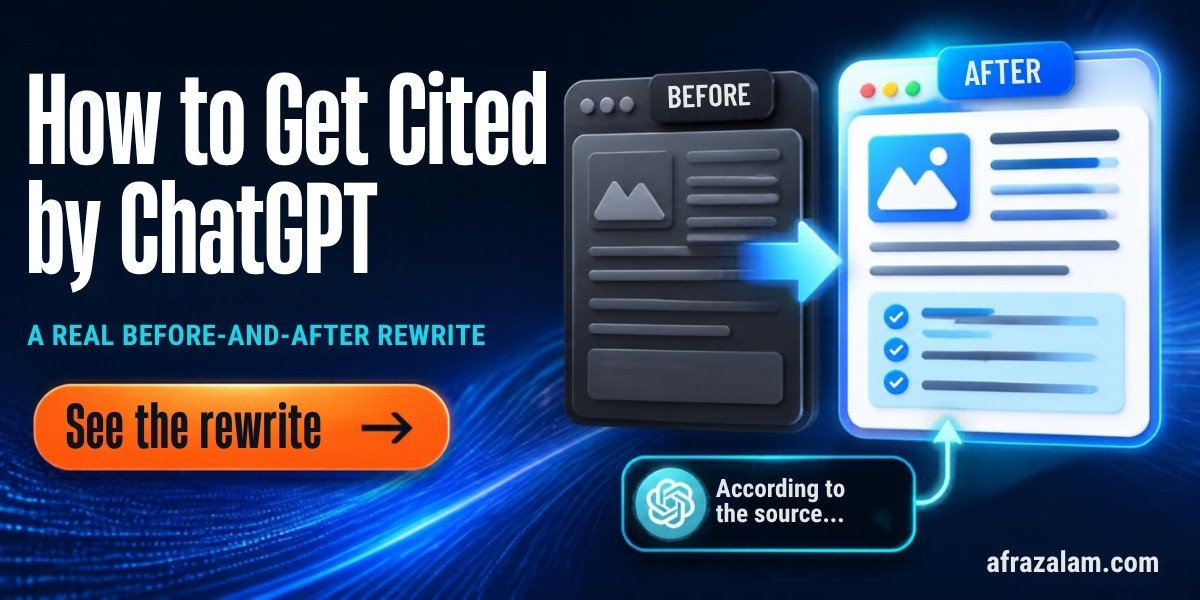
The Finished Before-and-After, Side by Side
| Before | After |
|---|---|
| Heading: Our Emergency Services | Heading: Who Does Emergency AC Repair in Phoenix, and How Fast Can They Arrive? |
| "At Desert Air, we understand that AC issues can happen at any time, especially during the hot summer months here in Phoenix. That's why our team of experienced technicians is dedicated to providing prompt, reliable emergency repair services whenever you need us..." | "Desert Air offers 24/7 emergency AC repair across Phoenix, with a technician dispatched within 60 minutes, day or night." Followed by the 2 adjacent questions on cost and warranty coverage, each with its own direct answer. |
| No named entities, no numbers, no schema, no visible update date | Real number (60 minutes), named entity (Desert Air), FAQPage schema, author byline, visible last-updated date |
Nothing about the actual service changed. Only the structure did. That is the entire point of this exercise, and it is why a rewrite is usually faster and cheaper than any other fix on this list.
Copy This Answer Capsule Template
Use this fill-in-the-blank structure for any page answering a direct customer question. Keep the finished capsule between 120 and 150 characters, and do not add a link inside it.
[Business] offers [specific service] in [city or service area], with [specific number: time, price, or guarantee].
Two more versions for content types outside home services:
Product or comparison page verdict: "[Product A] is the better choice for [specific use case], mainly because of [specific named difference], though [Product B] wins on [specific tradeoff]."
Coach or consultant offer page: "[Your name] helps [specific audience] achieve [specific, measurable outcome] using [named method or framework], typically within [realistic timeframe]."
All 3 templates follow the same underlying rule from the data above: a specific claim, a named entity, and no link, stated in the first sentence a reader or an AI system encounters.
Common Mistakes When Applying This Template
Most rewrites that don't work fail for the same handful of reasons, not because the framework is wrong.
The capsule runs too long. Once a capsule passes 150 characters, it starts reading like the opening of a paragraph again instead of a self-contained answer. If the sentence needs a comma-separated list of 3 or more qualifiers to feel complete, split it. The capsule states the answer. The paragraph underneath carries the qualifiers.
The old marketing heading survives below the new one. A common half-finished rewrite fixes the first heading on a page and leaves the rest in "Our Services" and "Why Choose Us" language. AI systems evaluate a page's overall structure, not just its opening. One good capsule surrounded by 5 vague headings still reads as a mostly-unstructured page.
The number gets vaguer, not more specific, in the rewrite. "Fast response times" becoming "quick and reliable service" is not a fix, it is the same problem in different words. Every rewrite pass should end with more named numbers and entities than it started with, not the same count restated.
Schema doesn't get updated to match the new headings. If FAQPage schema already exists on the page, it needs to mirror the new question-shaped headings exactly. Schema that still reflects the old "Our Emergency Services" structure while the visible page shows the new question format creates a mismatch between what a crawler reads and what a human sees, which is its own trust problem.
The rewrite happens once and never gets checked again. This is the R step skipped entirely. A page rewritten in September and never revisited is exactly the stale-content pattern the ANSWER framework's R step exists to prevent.
What This Rewrite Doesn't Fix
A content rewrite is not a complete AEO strategy on its own, and claiming otherwise would break the same honesty standard the rest of this framework depends on. Rewriting the words on a page does not fix a site Google cannot crawl in the first place, and it does not add the FAQPage or Article schema that actually makes the new structure machine-readable. If your technical foundation is not solid yet, start with our Technical SEO Audit Checklist before this rewrite work pays off. A perfectly structured answer on a page AI crawlers cannot reach does nothing.
It also does not guarantee a citation. Nothing does, and no honest source will tell you otherwise. What it does is move a page from the 13.2% citation group into the 34.3% group, based on real, published data, not a promise.
The Verdict
This exact rewrite process, applied page by page across a real site, is the content work I do for clients directly. Not a template handed over and left to guesswork, the actual line-by-line rewrite, matched to real customer questions, with the trust signals and schema added underneath it.
It connects to the rest of what I do at Afraz Alam Marketing Services in a straightforward way. A landing page built for Google Ads or Meta Ads traffic needs the exact same answer-first structure this article just walked through, because a visitor who lands confused converts at the same low rate an AI system that cannot extract your answer skips your page. And increasingly, an AI chatbot or on-site search workflow answering a visitor's question directly is just this same discipline applied inside your own website instead of outside it.
I'm not going to promise a specific citation result from this rewrite alone. What I can do is run this exact process against your highest-value pages, tell you honestly which ones are worth rewriting first, and build the fix.
Want your highest-value page rewritten like this one?
Book a free strategy call and I'll show you which pages to fix first.
Book a Free Strategy CallFAQ: Content Rewrites for AI Citation
What is an answer capsule?
A short, self-contained answer, 120 to 150 characters, placed immediately after a heading, with no links inside it. Search Engine Land found 72.4% of AI-cited blog posts included one, making it the strongest single predictor of citation in their audit.
Why should the answer capsule avoid links?
91% of cited answer capsules in the same audit contained no links at all. Links inside the capsule appear to interrupt the clean, quotable structure AI systems prefer to extract. Supporting links still belong in the paragraphs that follow, just not inside the capsule itself.
Do I need to rewrite my whole website?
No. Start with the single page answering your highest-value question, the one closest to an actual buying decision. The AEO pillar guide's own advice holds here too: pick one page and rewrite its opening two sentences first, then measure before doing the rest.
Will this rewrite guarantee my content gets cited by ChatGPT?
No, and treat any source that promises a guarantee as unreliable. What the data shows is a real, measured shift in the odds, from roughly 13.2% for pages with neither a capsule nor original data to 34.3% for pages with both.
How is this different from just adding an FAQ section?
An FAQ section without answer capsules and named entities is still a set of vague statements, just formatted as questions. The rewrite process here applies to every heading on a page, not only a bolted-on FAQ block at the bottom.
How long should the supporting paragraph be after the answer capsule?
Long enough to add real detail, short enough that the capsule above it is still doing the actual work. 2 to 4 sentences covering the specifics behind the capsule's claim is usually enough. If it needs a fifth sentence, that is a sign it belongs under its own question-shaped heading instead.
Does this work the same way for product pages as it does for service pages?
The underlying principle does, state the direct answer first, back it with a real number or named comparison. The exact question changes: a service page answers "who does X and how fast," a product page answers "is this worth it and how does it compare," which is why the templates above include a separate version for comparison and verdict content.
Want the real numbers on your own AI search visibility, not a guess?
I send real updates on SEO, automation, AI marketing, and paid media (Meta Ads and Google Ads) as they happen, plus case studies of how other businesses grow revenue through performance marketing.
Sign Up for the Newsletter